
If you’ve been searching for a calmer, more organized home — and more meaningful playtime for your child — you’re likely curious about whether a toy rotation system for kids actually works. The short answer? When done right, it can transform both your child’s focus and your daily routine.
Many parents feel overwhelmed by cluttered playrooms, overstimulated kids, and toys that seem to lose their appeal within days. This article breaks down exactly how a toy rotation system works, why it supports child development, and how to set one up in a way that’s simple and sustainable.
Drawing on current parenting research, child development principles, and real-world family strategies, we’ll walk you through practical steps, common mistakes to avoid, and easy ways to tailor the system to your child’s age and personality. By the end, you’ll know whether this approach fits your home — and how to start with confidence.
You know the scene. The playroom is overflowing—bins stuffed, dolls everywhere, blocks underfoot—yet your child sighs, “I’m bored.” It’s maddening. Not because they lack toys, but because they have too many. Psychologists call this decision fatigue (the mental overload from too many choices), and it crushes creativity.
After years of hands-on parenting, I learned clutter kills imagination. Kids don’t need more; they need less, presented intentionally.
Here’s the fix: a simple toy rotation system for kids.
- Store most toys out of sight
- Keep a small, curated selection available
- Swap every few weeks
Less chaos. Deeper play. Sanity restored for everyone.
The Surprising Benefits of a “Less is More” Approach to Play
A “less is more” approach simply means offering fewer toys at a time so children can focus deeply instead of jumping from one thing to the next. It sounds counterintuitive (aren’t more toys supposed to equal more fun?), but the results are powerful.
• Fosters Deeper Engagement: When choices are limited, children spend longer exploring a single toy’s possibilities. A set of blocks becomes a city, a zoo, or a spaceship—because there’s nothing competing for attention.
• Sparks Creativity and Imagination: Fewer options encourage inventive thinking. Psychologists call this divergent thinking—the ability to create multiple ideas from one object. A simple scarf can be a cape, a picnic blanket, or a river to jump over.
• Reduces Overwhelm and Anxiety: Too many visible toys can create overstimulation, meaning the brain struggles to process excess input. A tidy, calm space supports focus and emotional regulation.
• Builds Appreciation and Gratitude: Using a toy rotation system for kids helps toys “reappear” after a break, making them feel fresh and exciting again.
• Simplifies Cleanup: With fewer items out, children can manage their space independently (and yes, that means fewer stepped-on bricks at night).
Less clutter. More creativity. Clearer minds.
Step 1: The Great Toy Audit
Ready to see what you’re actually working with? Gather EVERY toy from every corner—under beds, in cars, behind couches (yes, even there). Spread them out in one visible space. Overwhelming? Maybe. Necessary? Absolutely.
Create three simple piles:
- Keep – Well-loved, age-appropriate, open-ended toys.
- Store – Still valuable but not currently in use.
- Donate/Discard – Broken, outgrown, or never played with.
Invite your child into the process in a gentle way. Ask, “Which toys make you happiest?” You might be surprised by their answers. This step builds decision-making skills and reduces resistance later.
Step 2: Categorize and Curate
Now that you’ve trimmed the excess, look at your “Keep” pile. Instead of tossing everything back randomly, group toys into categories: building blocks, puzzles, pretend play, art supplies, vehicles, sensory items.
Why categorize? Because variety fuels creativity. A balanced bin might include one construction toy, one imaginative play item, and one problem-solving activity. Think of it like packing a well-balanced lunch—different “nutrients” for the brain.
Have you ever noticed how kids ignore a mountain of toys but focus deeply on a small set? That’s the magic of thoughtful curation. You’re not limiting play; you’re spotlighting it.
This foundation makes your toy rotation system for kids simple and sustainable.
Step 3: Choose Your System & Schedule
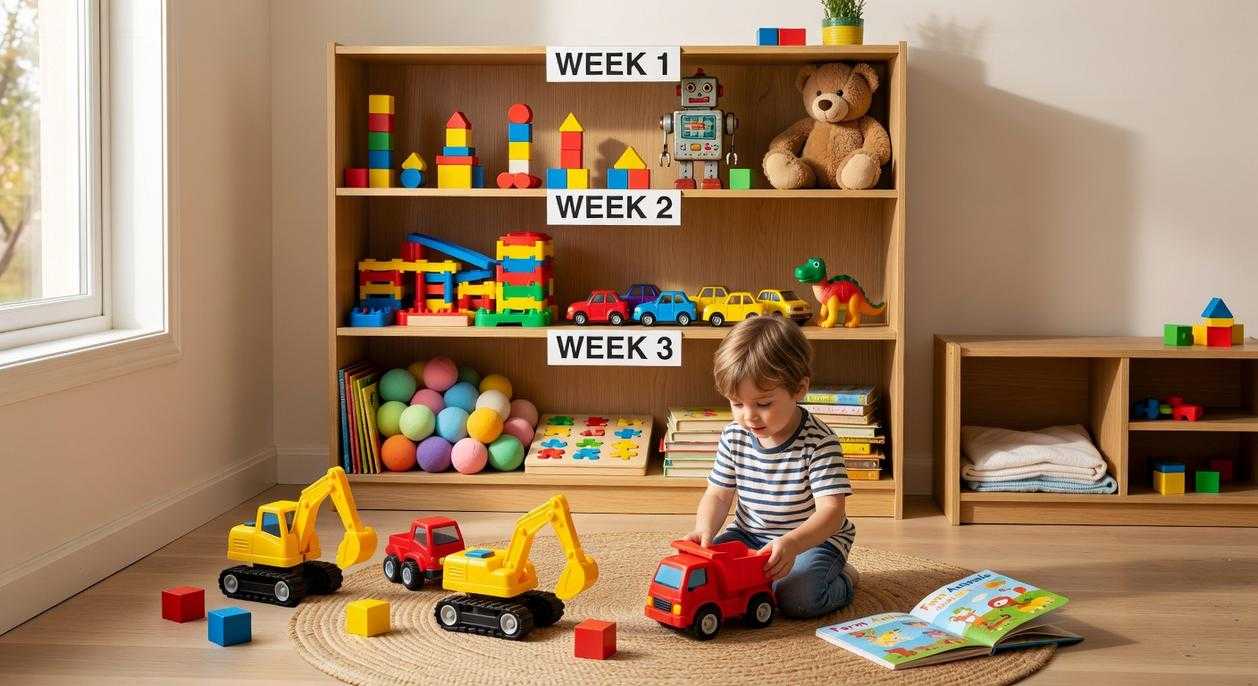
How do you store the “out” toys? Clear bins let you see contents instantly. Cloth baskets feel softer and blend into decor. Label everything clearly—words and pictures for pre-readers.
Store rotated toys in a closet, basement, or high shelf—somewhere OUT OF SIGHT. Visibility reduces novelty.
Next, choose a schedule:
- Weekly – Great for toddlers with short attention spans.
- Bi-weekly – A balanced, low-effort rhythm.
- Monthly – Ideal if life feels busy.
Wondering which is best? Watch your child. Are they bored after a few days—or deeply engaged for weeks? Let their behavior guide you.
Step 4: The “Grand Unveiling” and Maintenance
When rotation day comes, make it feel BIG. Set up toys neatly before your child wakes up or while they’re out. When they see the refreshed space, say, “Look what’s back!” Suddenly, old toys feel NEW again.
To maintain the system, adopt a one-in-one-out rule. New birthday gift? Choose one to store or donate. Quick resets each evening keep chaos from creeping back.
And if it slips sometimes? That’s normal. Systems serve families—not the other way around.
If you’re organizing beyond toys, explore creating a family command center that keeps everyone on track to bring calm to the rest of your home.
Adapting the System for Different Ages and Spaces
Every child is different, so what works beautifully for one may flop for another (parenting keeps us humble like that). I don’t pretend there’s a perfect formula, but age-based tweaks help.
For Toddlers (1–3 years): Focus on rotating sensory toys, stacking cups, simple puzzles, and sturdy board books. Attention spans are short, so weekly swaps often work best. The toy rotation system for kids can reduce overwhelm, though some toddlers may resist change at first.
For Preschoolers (3–5 years): Try themed bins—a “dinosaur dig,” a “doctor kit,” or a building lab. Pretend play deepens at this stage, but it’s not always clear how many choices are ideal. Invite them to help choose what stays out.
For Small Spaces: Apartments call for creativity. Use under-bed bins, vertical closet organizers, and storage ottomans. Think vertically whenever possible. I can’t promise a clutter-free home, but thoughtful rotation makes limited space feel bigger.
Common Pitfalls and How to Keep the System Working
Even the best toy rotation system for kids can hit a snag (because toddlers have PhDs in chaos).
Problem: A favorite toy disappears and—boom—Oscar-worthy meltdown.
Fix: Keep a small, easy-to-reach basket of “can’t-live-without” comfort toys. Think of it as the VIP lounge for stuffed animals.
Problem: The system feels rigid.
Fix: Stay flexible. If your child is building a Lego metropolis, let it stand. Who wants a zoning inspector at age four?
Problem: You forget what’s stored away.
Fix: Snap quick photos or label bins simply. Future-you will be grateful. Later.
By starting a toy rotation system for kids, you’ve already tackled clutter and the nagging boredom that follows. Honestly, I can’t promise it fixes every chaotic afternoon, but it often creates calmer rooms and deeper, more imaginative play. So begin today—just sort one small category and see what happens next.
Create a Calmer, Happier Play Space Starting Today
You came here looking for practical ways to simplify playtime, reduce clutter, and keep your child genuinely engaged. Now you understand how a toy rotation system for kids can transform overwhelming toy piles into intentional, meaningful play experiences.
When toys are always available, children feel overstimulated, bored, and disconnected. And as a parent, the constant mess and wasted money on unused toys can feel exhausting. A thoughtful rotation system solves both problems—encouraging creativity, extending the life of toys, and creating a calmer home environment.
Start small. Choose a limited number of toys to display this week, store the rest out of sight, and observe how your child interacts differently. Rotate every few weeks based on their interests and developmental stage.
If you’re ready to reduce chaos, spark deeper play, and make your home feel lighter, begin your toy rotation system for kids today. Families who use this approach report less clutter, more focused play, and happier routines. Take the first step now—your calmer playroom (and your sanity) will thank you.