
Parenting advice is everywhere—but finding guidance that actually works in the middle of tantrums, sleepless nights, and daily chaos is another story. If you’re searching for practical parenting tips rooted in empathy in discipline, you’re likely looking for approaches that nurture connection without sacrificing boundaries.
This article is designed to help you do exactly that. We break down gentle parenting strategies, realistic childcare hacks, and simple wellness shifts that support both your child’s growth and your own well-being. Instead of quick fixes, you’ll find thoughtful, research-informed insights grounded in child development principles and modern behavioral science.
Our guidance draws from established parenting frameworks, expert recommendations, and real-world application—so you can feel confident putting these ideas into practice. Whether you’re navigating toddler meltdowns or building stronger daily routines, you’ll discover balanced, compassionate strategies that make family life calmer, more connected, and more intentional.
The Gentle Path to Effective Discipline
By fostering empathy in our parenting approach, we not only create understanding and connection but also enhance our ability to engage with entertaining and educational resources, as explored in our Entertainment Guide Cwbiancaparenting.
Discipline often gets confused with punishment, but they are not the same. Simply put, discipline means teaching, while punishment focuses on control. Many parents swing between permissive parenting and harsh consequences, wondering, “Am I too strict?”
Discipline blends clear boundaries with warmth. In practice, that looks like naming the behavior, explaining its impact, and guiding a better choice. For example, if your child throws a toy, you might remove it briefly and say, “Toys aren’t for throwing.”
Use empathy in discipline to acknowledge feelings without excusing actions. Over time, this builds trust and self-esteem.
Beyond Time-Outs: What Compassionate Discipline Really Means
When we talk about discipline, we’re talking about teaching. The word itself comes from the Latin disciplina, meaning instruction or knowledge. Punishment, on the other hand, is about imposing a penalty for wrongdoing. One aims to build skills; the other aims to control behavior. They can look similar on the surface (a child sits out either way), but the intention underneath matters.
Compassionate discipline is often misunderstood as permissiveness. It’s not. Boundaries still exist. Consequences still happen. The difference is how they’re delivered. You hold the line, but with empathy in discipline rather than shame. Think Professor McGonagall—firm, clear, but never cruel.
At its core are a few principles:
- Connection before correction
- Understanding the need behind the behavior
- Validating feelings even when the action isn’t okay
A child who hits may be overwhelmed, lacking impulse control, or craving attention. Addressing only the hitting misses the root cause. Addressing the big emotion or lagging skill teaches something lasting.
I’ll be honest: researchers still debate which methods work best long term, and no approach guarantees smooth days. But focusing on root causes instead of surface behavior gives children tools—not just consequences.
I remember the first time my toddler melted down in the grocery store. One minute we were choosing apples, the next he was on the floor, sobbing because I wouldn’t buy cereal with a cartoon dragon on it. My instinct was to lecture. But his eyes were glazed over—he wasn’t listening.
Here’s why: when a child is overwhelmed, the prefrontal cortex—often called the “thinking brain” (the part responsible for logic, decision-making, and impulse control)—goes offline. In that moment, expecting a lesson to stick is like trying to reason with someone who just woke up from anesthesia. It’s not defiance; it’s neurology.
Cortisol and Conflict
Harsh discipline raises cortisol, the body’s primary stress hormone (Harvard Center on the Developing Child). Elevated cortisol keeps kids in a “fight, flight, or freeze” state—survival mode. In survival mode, learning pauses.
| State | What’s Happening in the Brain | Result |
|---|---|---|
| Calm | Prefrontal cortex active |
Learning possible |
| Stressed | Cortisol surges, alarm system on | Reactivity, no reasoning |
Some argue that strict consequences build toughness. I understand the appeal (no one wants a child who crumbles at “no”). But research shows chronic stress impairs emotional regulation, not strengthens it (American Academy of Pediatrics).
The Power of Co-Regulation
When I knelt beside my son, lowered my voice, and said, “You’re really disappointed,” his breathing slowed. That’s co-regulation—a calm adult nervous system helping a child’s system settle. This is empathy in discipline. Once calm returned, we could talk.
Building Long-Term Skills
Moments like these wire the brain. Repeated soothing strengthens neural pathways for self-control, problem-solving, and emotional intelligence. You’re not just ending a tantrum—you’re building the architecture for resilience (Center on the Developing Child).
From Theory to Tantrum: Your Actionable Guide
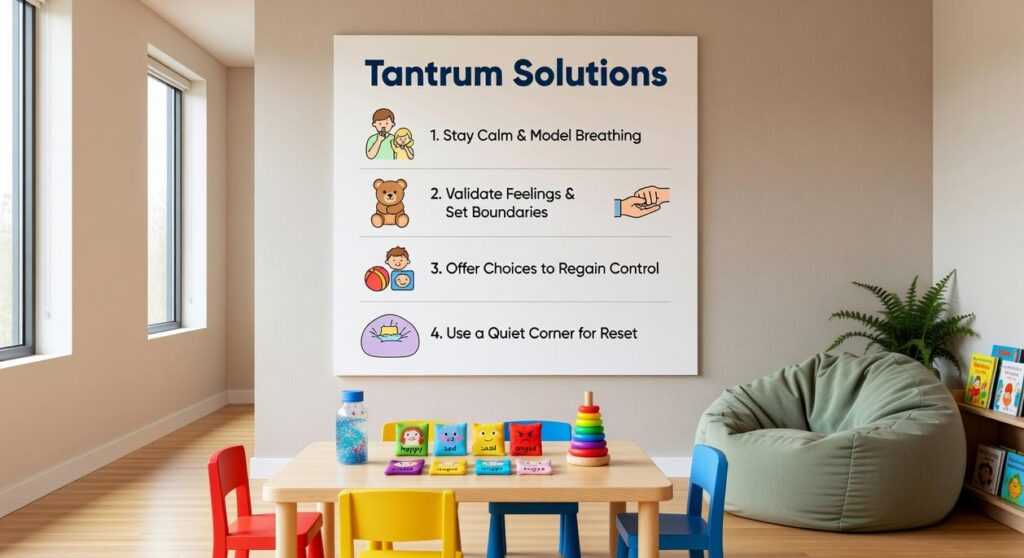
Every parent knows the theory. Stay calm. Be patient. Teach, don’t punish. And then the tantrum hits in the cereal aisle like a plot twist in a sitcom (cue dramatic music). What most guides miss is the how in the heat of the moment. Here’s a practical framework that bridges neuroscience, emotional regulation, and real-life chaos.
-
Model Calmness
Before reacting, pause. Take one slow breath. This isn’t fluffy advice—it’s co-regulation, a term psychologists use to describe how children borrow your nervous system to steady theirs (Center on the Developing Child, Harvard University). Your calm is contagious. Acknowledge your frustration internally, but respond intentionally. -
Connect Before You Correct
Kneel to their eye level. Soften your tone. Validation doesn’t mean agreement; it means recognition. “I see you’re angry that screen time is over.” Studies show children who feel understood escalate less (Gottman Institute). This is where many competitors stop at “be firm”—but connection first actually reduces repeat meltdowns. -
Set a Clear and Kind Boundary
“It is not okay to throw the tablet. I’m putting it away to keep it safe.” Boundaries without shame build security. You can use empathy in discipline while still holding the line. -
Use Natural and Logical Consequences
If blocks are thrown, they’re put away. Logical consequences directly relate to behavior, which research shows improves learning retention (American Academy of Pediatrics). Random punishments? Less effective. -
Problem-Solve Together (Later)
Once calm, revisit: “What’s a better way to show anger next time?” This builds executive function—decision-making and impulse control skills crucial for long-term resilience.
Some argue this approach is too soft. But discipline rooted in fear may stop behavior short term, while connection builds internal regulation long term. If your goal is breaking generational parenting patterns with compassion, this method isn’t indulgent—it’s strategic.
Last week, my child spilled juice, looked at me, and braced for impact. I chose a breath over a lecture. That moment redefined strength for me. Real strength is self-control—the ability to model empathy in discipline instead of anger (which is easy, let’s be honest).
Some argue this is “soft.” I disagree. Being calm and firm at the same time is harder than yelling.
Consistency matters, but it means:
- Clear boundaries
- Calm follow-through
- Predictable consequences
When others question you, try: “I’m parenting for who my child becomes, not for this moment.” Long-term character beats short-term compliance.
Building a legacy of emotional health starts with clarity. Connection before correction means pausing to see the feeling beneath the behavior.
- Notice the emotion.
- Name it calmly.
- Guide the response.
This is empathy in discipline: teaching regulation, not fear. Try one small moment today and watch trust grow intentionally unfold.
Building Calmer, More Connected Moments at Home
You came here looking for practical, compassionate ways to handle discipline without yelling, guilt, or second-guessing yourself. Now you have a clearer path forward—one rooted in connection, consistency, and empathy in discipline.
Parenting can feel overwhelming when every meltdown turns into a power struggle. The exhaustion, the doubt, the fear of “getting it wrong”—it’s heavy. But discipline doesn’t have to damage connection. When you lead with calm boundaries and emotional awareness, you teach your child how to regulate, not just how to obey.
That’s your next step: pause before reacting, validate feelings, hold the boundary, and stay consistent. Small shifts repeated daily create lasting change.
If you’re tired of shouting and ready for a more peaceful home, don’t try to figure it out alone. Join thousands of parents who trust our gentle, research-backed parenting resources to transform chaos into cooperation. Explore our proven tools and start building calmer days today.
 Vynric Velmyre has opinions about childcare hacks for busy moms. Informed ones, backed by real experience — but opinions nonetheless, and they doesn't try to disguise them as neutral observation. They thinks a lot of what gets written about Childcare Hacks for Busy Moms, Fresh Insights, Curious Collections is either too cautious to be useful or too confident to be credible, and they's work tends to sit deliberately in the space between those two failure modes.
Reading Vynric's pieces, you get the sense of someone who has thought about this stuff seriously and arrived at actual conclusions — not just collected a range of perspectives and declined to pick one. That can be uncomfortable when they lands on something you disagree with. It's also why the writing is worth engaging with. Vynric isn't interested in telling people what they want to hear. They is interested in telling them what they actually thinks, with enough reasoning behind it that you can push back if you want to. That kind of intellectual honesty is rarer than it should be.
What Vynric is best at is the moment when a familiar topic reveals something unexpected — when the conventional wisdom turns out to be slightly off, or when a small shift in framing changes everything. They finds those moments consistently, which is why they's work tends to generate real discussion rather than just passive agreement.
Vynric Velmyre has opinions about childcare hacks for busy moms. Informed ones, backed by real experience — but opinions nonetheless, and they doesn't try to disguise them as neutral observation. They thinks a lot of what gets written about Childcare Hacks for Busy Moms, Fresh Insights, Curious Collections is either too cautious to be useful or too confident to be credible, and they's work tends to sit deliberately in the space between those two failure modes.
Reading Vynric's pieces, you get the sense of someone who has thought about this stuff seriously and arrived at actual conclusions — not just collected a range of perspectives and declined to pick one. That can be uncomfortable when they lands on something you disagree with. It's also why the writing is worth engaging with. Vynric isn't interested in telling people what they want to hear. They is interested in telling them what they actually thinks, with enough reasoning behind it that you can push back if you want to. That kind of intellectual honesty is rarer than it should be.
What Vynric is best at is the moment when a familiar topic reveals something unexpected — when the conventional wisdom turns out to be slightly off, or when a small shift in framing changes everything. They finds those moments consistently, which is why they's work tends to generate real discussion rather than just passive agreement.