

If you’re searching for practical home organization tips for parents, you’re likely juggling packed schedules, endless to-do lists, and the daily chaos that comes with raising kids. Staying organized isn’t about picture-perfect shelves—it’s about creating systems that make your home run smoother and your days feel lighter.
This article is designed to give you realistic, family-friendly strategies that actually work in busy households. From simplifying toy storage to setting up routines that children can follow, we focus on solutions that reduce stress and save time.
Our guidance is built on research-backed parenting approaches, real-life testing, and insights from child development and household management experts. Every tip is chosen with one goal in mind: helping you create a calmer, more functional space without adding more pressure to your plate.
By the end, you’ll have clear, actionable ideas you can start using right away to bring more order—and more peace—into your home.
From Chaos to Calm: A Parent’s Guide to Household Harmony
Parenthood is loud, relentless, and beautiful—yet clutter quietly amplifies the stress. When laundry piles up and toys migrate like determined nomads, organization feels impossible. However, perfection is not the goal; functionally calm is. This guide offers realistic, low-effort home organization tips for parents that work in real homes.
Start small: create drop zones by the door, rotate toys weekly, and reset rooms for ten minutes nightly. For clarity, try:
| Zone | Action | Benefit |
| Entry | Basket for shoes | Fewer morning meltdowns |
| Kitchen | Clear counter nightly | Easier breakfasts |
Calm grows through tiny systems.
The Mindset Shift: Embracing “Good Enough” for a Happier Home”
Let’s be honest: the idea of a flawless home sounds lovely, but it’s often exhausting. We’re told to aim for magazine-worthy spaces, yet real life looks more like backpacks on the floor and dishes soaking in the sink. I can’t promise that embracing “good enough” solves everything, but I’ve seen how shifting the goal from perfection to function changes the mood of a home. A livable space beats a picture-perfect one every time.
That’s where the 80/20 rule comes in. In other words, focus 80% of your effort on the 20% of spaces that cause daily stress—like the entryway or kitchen counter. Tidy those first. The rest? Let it be for now.
Meanwhile, involve your kids. Even toddlers can toss toys in bins. Frame it as teamwork, not a chore. Over time, small habits grow. If you’re looking for home organization tips for parents, start there—and adjust as you learn what truly works for your family.
Creating a Family Command Center: Your Household’s Mission Control
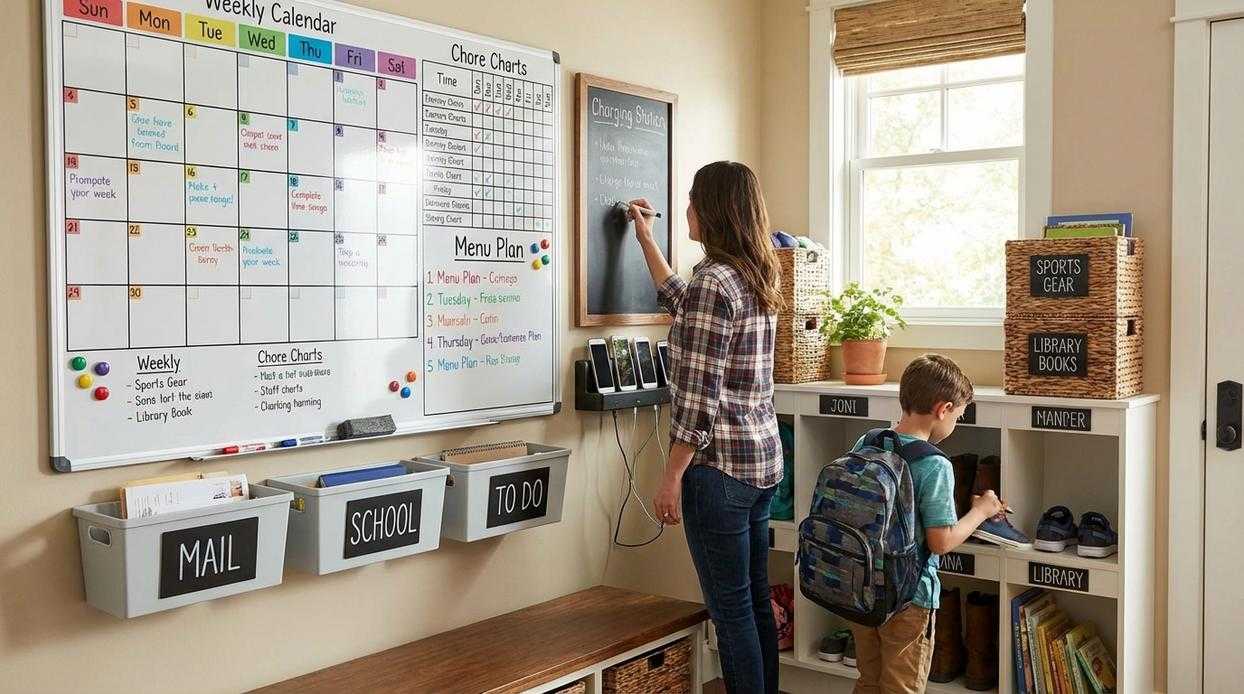
If your home sometimes feels like a small airport with no departure board, you’re not alone. A family command center is your visible, no-excuses hub for schedules, papers, and dinner plans. It cuts down on the daily chorus of “What’s for dinner?” and “Where are my shoes?” (Spoiler: exactly where they left them.)
Key Components
A Shared Calendar
A large whiteboard calendar is bold, visual, and impossible to ignore. Everyone can see soccer practice at 5 p.m.—no “I didn’t know” defense. The downside? You can’t take it with you. A synced digital calendar travels in your pocket and sends reminders (bless technology), but it’s only useful if everyone actually checks it. Many families use both: whiteboard for visibility, digital for alerts.
The Action Basket
Designate one basket for school forms, mail, and bills that need attention. Just one. Not five. Process it weekly so it doesn’t become a paper monster. This is one of those underrated home organization tips for parents that quietly saves your sanity.
Meal Plan Display
Post the weekly menu. It reduces decision fatigue and ends daily negotiations. Bonus: kids complain less when they can see Taco Tuesday in writing. Mission control, achieved.
Taming the Toy Tsunami: Simple Systems for Playtime Clutter
If you’ve ever stepped on a rogue LEGO at 10 p.m., you already know: toy clutter is no joke. I used to think more storage was the answer. It wasn’t. The real magic? Fewer toys in sight.
The Power of Toy Rotation
Toy rotation simply means storing a portion of toys out of sight and swapping them every few weeks. Child development research shows that too many choices can overwhelm kids and reduce focus (American Academy of Pediatrics, 2018). When we rotate, “old” toys suddenly feel brand new (like a surprise sequel that’s actually good). Pro tip: keep rotation bins out of reach so curiosity stays high.
That said, some parents argue kids should have access to everything to encourage independence. I get that. But in my experience, a curated shelf sparks deeper, longer play.
Categorize and Contain
Clear bins with picture labels—like a photo of blocks taped to the block bin—help pre-readers build independence. Visual cues (images that guide behavior) reduce constant “Where does this go?” questions. It’s one of my favorite home organization tips for parents because it teaches responsibility without nagging.
For more creative ways to make cleanup meaningful, explore creative ways to turn daily chores into learning moments.
The ‘One In, One Out’ Rule
When birthdays hit, one toy enters, one leaves. Some say it’s too strict. I say it protects your living room from looking like a toy store exploded.
The 10-Minute Tidy-Up
Finally, set a timer, blast a favorite song, and tidy before bed. Ten minutes daily beats a two-hour weekend meltdown. (Think less Cinderella, more speed round.)
Streamlining Daily Routines: Hacks for Mornings, Meals, and Laundry
Mornings don’t have to feel like a fire alarm blaring in human form. The “Launch Pad” method—a designated spot by the door for backpacks, shoes, keys, and jackets—turns chaos into calm. Set it up the night before. When everything is lined up neatly, zippers closed and sneakers paired, the morning feels quieter, almost lighter. (It’s amazing how much stress hides in a missing shoe.)
In the kitchen, think eye-level and easy reach. A kid-accessible snack drawer—containers you can hear softly clack open—lets children grab granola bars or apple slices without tugging at you while dinner sizzles. Dedicate one hour on Sunday to:
- Chop crisp bell peppers and carrots
- Portion sandwich fillings
- Wash and dry berries so they’re ready to tumble into lunchboxes
The fridge looks colorful and inviting, and weekday lunches become assembly, not chaos. Pro tip: clear bins make ingredients visible, which increases the odds they’ll actually get eaten.
Then there’s laundry. Instead of facing a towering “laundry mountain” on Saturday (you know the one), run one small load daily from wash to fold. Warm towels straight from the dryer feel comforting, not overwhelming. This simple rhythm is one of those underrated home organization tips for parents that keeps the house humming softly instead of roaring.
Lasting order isn’t a finish line. It’s a rhythm you return to, again and again. When you first searched for home organization tips for parents, were you staring at a mountain of laundry and wondering how it got this bad? Sound familiar?
Perfection was never the goal. Flexible systems are.
- Try a simple “Launch Pad” by the door.
- Do a nightly 10-Minute Tidy-Up.
Small shifts create a ripple effect of calm (yes, really).
What if this week you chose just one drawer, one corner, one habit? Progress over perfection—that’s how families truly stay organized. Start small. Keep going.
Create a Calmer, More Organized Home Starting Today
You came here looking for realistic ways to make parenting feel lighter, your home feel calmer, and your daily routines feel less chaotic. Now you have practical strategies you can actually use — from gentle structure shifts to simple home organization tips for parents that reduce stress instead of adding to it.
The truth is, clutter, noise, and constant overwhelm don’t just drain your energy — they affect your patience, your focus, and the tone of your home. Small, intentional changes create breathing room. And when your space supports you, parenting feels more manageable and more joyful.
Now it’s time to take action. Choose one area — just one — and apply what you’ve learned today. Reset that entryway. Simplify that toy shelf. Create that 10‑minute evening tidy routine. Consistency beats perfection every time.
If you’re ready for calmer days, smarter systems, and parenting support that actually works in real life, explore more of our trusted, parent‑approved guidance. Thousands of families rely on our practical insights to simplify motherhood and reclaim peace at home.
Start today — your calmer home (and calmer mind) begins with one small step.
 Vynric Velmyre has opinions about childcare hacks for busy moms. Informed ones, backed by real experience — but opinions nonetheless, and they doesn't try to disguise them as neutral observation. They thinks a lot of what gets written about Childcare Hacks for Busy Moms, Fresh Insights, Curious Collections is either too cautious to be useful or too confident to be credible, and they's work tends to sit deliberately in the space between those two failure modes.
Reading Vynric's pieces, you get the sense of someone who has thought about this stuff seriously and arrived at actual conclusions — not just collected a range of perspectives and declined to pick one. That can be uncomfortable when they lands on something you disagree with. It's also why the writing is worth engaging with. Vynric isn't interested in telling people what they want to hear. They is interested in telling them what they actually thinks, with enough reasoning behind it that you can push back if you want to. That kind of intellectual honesty is rarer than it should be.
What Vynric is best at is the moment when a familiar topic reveals something unexpected — when the conventional wisdom turns out to be slightly off, or when a small shift in framing changes everything. They finds those moments consistently, which is why they's work tends to generate real discussion rather than just passive agreement.
Vynric Velmyre has opinions about childcare hacks for busy moms. Informed ones, backed by real experience — but opinions nonetheless, and they doesn't try to disguise them as neutral observation. They thinks a lot of what gets written about Childcare Hacks for Busy Moms, Fresh Insights, Curious Collections is either too cautious to be useful or too confident to be credible, and they's work tends to sit deliberately in the space between those two failure modes.
Reading Vynric's pieces, you get the sense of someone who has thought about this stuff seriously and arrived at actual conclusions — not just collected a range of perspectives and declined to pick one. That can be uncomfortable when they lands on something you disagree with. It's also why the writing is worth engaging with. Vynric isn't interested in telling people what they want to hear. They is interested in telling them what they actually thinks, with enough reasoning behind it that you can push back if you want to. That kind of intellectual honesty is rarer than it should be.
What Vynric is best at is the moment when a familiar topic reveals something unexpected — when the conventional wisdom turns out to be slightly off, or when a small shift in framing changes everything. They finds those moments consistently, which is why they's work tends to generate real discussion rather than just passive agreement.