
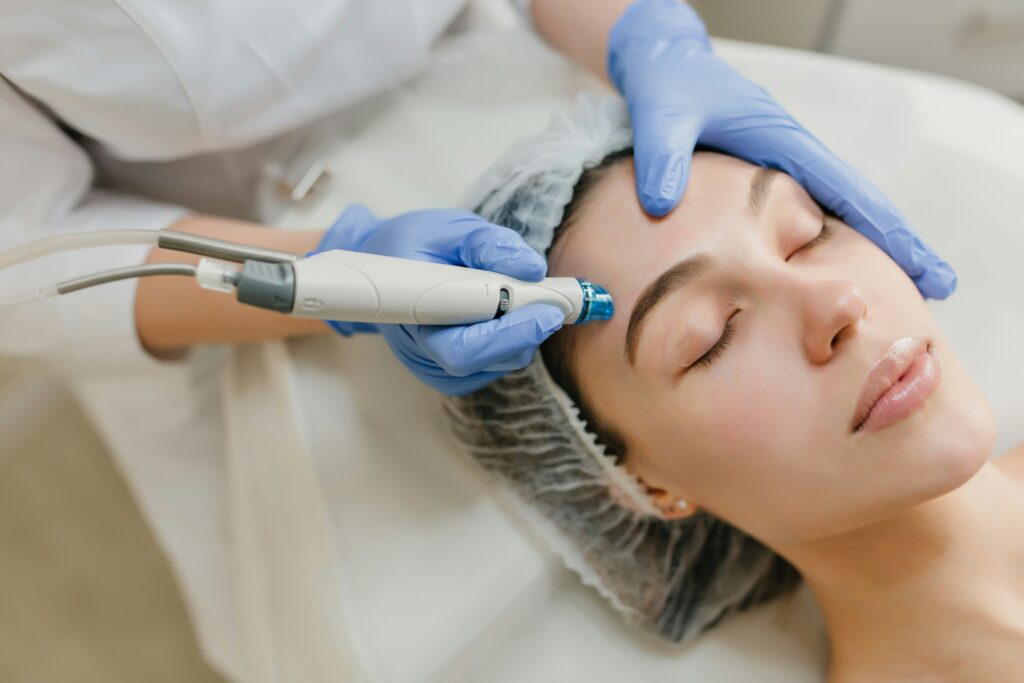
If you’ve spent any time scrolling skincare content lately, you’ve probably seen dermaplaning mentioned as the secret behind that “glass skin” glow. It’s one of those treatments that sounds intimidating — a blade, on your face? — but once you understand what’s actually happening, it starts to make a lot of sense. Dermaplaning is a simple, non-invasive exfoliation treatment that’s become a staple in facials and skincare routines for people who want smoother, brighter, more radiant skin without any downtime. Let’s break down exactly what it is, how it works, and whether it’s the right addition to your skincare routine.
What Is Dermaplaning?
Dermaplaning is a manual exfoliation technique performed by an esthetician using a sterile surgical scalpel held at a precise angle against the skin. The practitioner gently glides the blade across the surface of the face in short, feathering strokes, removing the very top layer of dead skin cells along with vellus hair — the fine, soft “peach fuzz” that naturally grows on the face.
Unlike shaving, dermaplaning isn’t about hair removal for cosmetic reasons alone. It’s primarily an exfoliation treatment; the removal of peach fuzz is more of a welcome side effect than the main event. By clearing away dead skin buildup and fine hair, the treatment reveals fresher, smoother skin underneath and allows your skincare products to absorb more effectively afterward.
The procedure is entirely non-invasive. There are no chemicals, no needles, and no injections involved — just a blade and a trained hand. Most sessions take between 30 and 45 minutes, and many spas pair dermaplaning with a hydrating or brightening facial to maximize the results.
The Benefits of Dermaplaning
The appeal of dermaplaning goes well beyond the immediate “wow, my skin feels so soft” reaction right after treatment. Here’s what makes it worth considering:
Instant smoothness. Because dead skin and fine hair are physically removed, skin feels noticeably softer immediately after treatment — many clients compare it to running their hand over silk.
Brighter, more even complexion. Removing the outer layer of dull, dead skin cells reveals the healthier skin underneath, which tends to look brighter and more even-toned.
Better makeup application. Without peach fuzz or rough texture in the way, foundation and other makeup products glide on more smoothly and look less cakey or patchy.
Enhanced product absorption. Serums, moisturizers, and treatment products penetrate more effectively when they’re not fighting through a layer of dead skin and hair.
No downtime. Unlike more aggressive treatments such as chemical peels or laser resurfacing, dermaplaning doesn’t require recovery time. You can return to your normal routine — makeup and all — immediately after your appointment.
Reduced appearance of fine lines and acne scarring. While not a substitute for more targeted treatments, the exfoliation involved can soften the look of fine lines and shallow acne scars over time.
What to Expect During Your Treatment
If you’ve never had dermaplaning done before, the process is far gentler than it sounds. Your esthetician will start by cleansing your skin thoroughly to remove any makeup, oil, or debris. Then, using a sterile scalpel, they’ll hold your skin taut and glide the blade across your face at a 45-degree angle in short, controlled strokes — typically covering the cheeks, forehead, chin, and sometimes the upper lip and jawline.
You shouldn’t feel any pain during the procedure. Most people describe the sensation as similar to a gentle scraping or a light tickling feeling, nothing sharp or uncomfortable. There’s no need for numbing cream or anesthesia. Once the exfoliation is complete, your esthetician will typically follow up with a soothing serum, moisturizer, and sunscreen to protect your freshly revealed skin.
Dermaplaning vs. Other Exfoliation Methods
It’s worth understanding how dermaplaning stacks up against other popular exfoliation treatments, since they’re often confused with one another.
Microdermabrasion uses a device with an abrasive tip or crystals to mechanically buff away dead skin cells. It’s more aggressive than dermaplaning and can sometimes cause mild redness or sensitivity afterward, whereas dermaplaning tends to be gentler on the skin barrier.
Chemical peels rely on acids to dissolve the bonds between dead skin cells, encouraging them to shed. Peels can penetrate deeper into the skin and are often used for more targeted concerns like hyperpigmentation, but they typically involve some visible peeling or flaking during recovery — something dermaplaning avoids entirely.
Dermaplaning sits in a nice middle ground: it’s physical exfoliation without the intensity of microdermabrasion, and it doesn’t involve any chemical reaction, redness, or peeling. That’s part of why it’s such a popular choice for people who want visible results with zero recovery time, including many clients searching for options like dermaplanning in Westport who want a treatment they can fit into a lunch break and head straight back to work or a dinner reservation afterward.
Who Should (and Shouldn’t) Get Dermaplaning
Dermaplaning is generally considered safe for most skin types, and it’s an especially good option for people with dry or sun-damaged skin that benefits from manual exfoliation. It’s also a great pick for anyone who is pregnant or breastfeeding and wants to avoid the chemical exfoliants that are often discouraged during those periods, since dermaplaning involves no active ingredients being absorbed into the skin.
That said, it’s not for everyone. People with active acne breakouts should typically avoid dermaplaning in the affected areas, since dragging a blade across inflamed or broken skin can spread bacteria and worsen breakouts. The same goes for anyone with active cold sores, open wounds, sunburn, or certain inflammatory skin conditions like rosacea flare-ups. If you’re using strong retinoids or have recently had other resurfacing treatments, it’s worth checking in with your esthetician about timing before booking a session.
Common Myths About Dermaplaning
A lot of hesitation around dermaplaning comes from misconceptions. The biggest one: “won’t my hair grow back thicker and darker?” The answer is no. Vellus hair (peach fuzz) doesn’t have the same growth cycle or follicle structure as terminal hair like eyebrows or scalp hair, so shaving or dermaplaning it doesn’t change its thickness, color, or growth rate. It will grow back exactly as it was before — fine, soft, and barely visible.
Another myth is that dermaplaning “thins” the skin over time. In reality, it only removes the outermost layer of already-dead cells, the same cells your skin naturally sheds on its own. Done correctly by a trained professional, it doesn’t damage or thin the deeper layers of skin.
Aftercare Tips
Because dermaplaning removes a protective layer of dead skin, your skin will be slightly more sensitive to the sun immediately afterward. Sunscreen is non-negotiable for at least the following week — ideally, it should already be part of your daily routine. It’s also smart to avoid harsh exfoliating products, retinoids, or intense workouts that cause heavy sweating for a day or two post-treatment, just to let your skin settle. Many people find their skin feels its best three to five days after treatment, once any initial sensitivity has fully calmed down.
How Often Should You Get Dermaplaning?
Because dermaplaning only addresses the surface layer of skin, results aren’t permanent — dead skin cells and hair naturally regenerate over time. Most estheticians recommend scheduling treatments every three to four weeks, which lines up conveniently with the skin’s natural renewal cycle. Some people choose to time their sessions around big events, like a wedding or a milestone birthday, to make sure their skin is at its smoothest for photos.
Choosing the Right Provider
Because dermaplaning involves a blade, technique and hygiene matter enormously. It should always be performed by a licensed, trained esthetician using a single-use, sterile blade for each client. When researching providers, look for reviews that specifically mention dermaplaning experience, ask whether the spa uses fresh blades for every session, and don’t hesitate to ask how many treatments they’ve performed. A good provider will also take the time to assess your skin beforehand and tell you honestly if dermaplaning isn’t the right fit for your current skin condition.
The Takeaway
Dermaplaning has earned its popularity for good reason: it’s quick, painless, requires zero downtime, and delivers immediately visible results. Whether you’re prepping for a special event or simply want to build a more effective long-term skincare routine, it’s a treatment worth discussing with your esthetician.
As with any professional skin treatment, the results depend heavily on the skill of the person holding the blade — so choose your provider carefully, communicate your skin goals clearly, and enjoy the smoother, brighter complexion that follows.
 Ask Anthony Coughlinazey how they got into curious collections and you'll probably get a longer answer than you expected. The short version: Anthony started doing it, got genuinely hooked, and at some point realized they had accumulated enough hard-won knowledge that it would be a waste not to share it. So they started writing.
What makes Anthony worth reading is that they skips the obvious stuff. Nobody needs another surface-level take on Curious Collections, Childcare Hacks for Busy Moms, Bolytex Gentle Parenting Deep Dives. What readers actually want is the nuance — the part that only becomes clear after you've made a few mistakes and figured out why. That's the territory Anthony operates in. The writing is direct, occasionally blunt, and always built around what's actually true rather than what sounds good in an article. They has little patience for filler, which means they's pieces tend to be denser with real information than the average post on the same subject.
Anthony doesn't write to impress anyone. They writes because they has things to say that they genuinely thinks people should hear. That motivation — basic as it sounds — produces something noticeably different from content written for clicks or word count. Readers pick up on it. The comments on Anthony's work tend to reflect that.
Ask Anthony Coughlinazey how they got into curious collections and you'll probably get a longer answer than you expected. The short version: Anthony started doing it, got genuinely hooked, and at some point realized they had accumulated enough hard-won knowledge that it would be a waste not to share it. So they started writing.
What makes Anthony worth reading is that they skips the obvious stuff. Nobody needs another surface-level take on Curious Collections, Childcare Hacks for Busy Moms, Bolytex Gentle Parenting Deep Dives. What readers actually want is the nuance — the part that only becomes clear after you've made a few mistakes and figured out why. That's the territory Anthony operates in. The writing is direct, occasionally blunt, and always built around what's actually true rather than what sounds good in an article. They has little patience for filler, which means they's pieces tend to be denser with real information than the average post on the same subject.
Anthony doesn't write to impress anyone. They writes because they has things to say that they genuinely thinks people should hear. That motivation — basic as it sounds — produces something noticeably different from content written for clicks or word count. Readers pick up on it. The comments on Anthony's work tend to reflect that.